
Print


01 11 2026 10:58
News Code : 283920571
View Count : 63
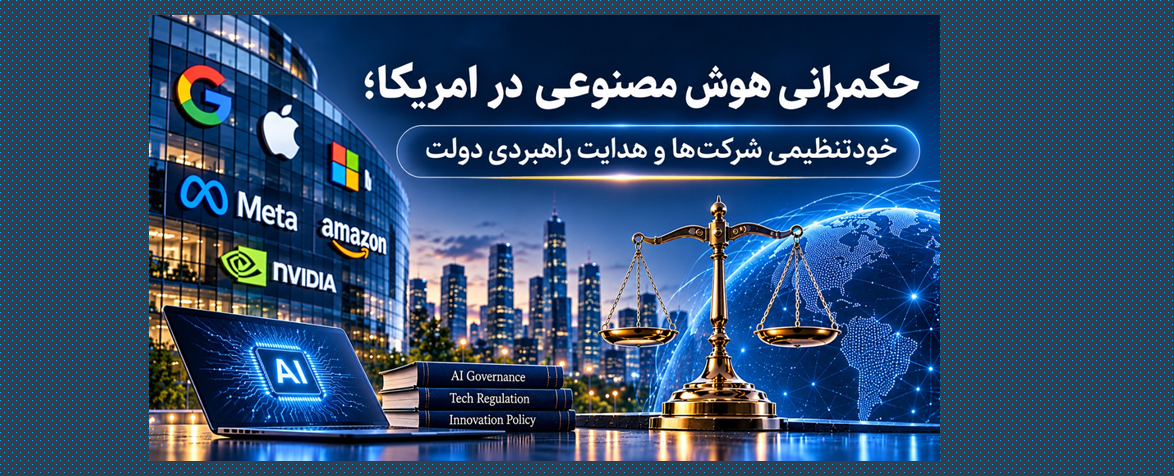
AI Governance in the United States: Corporate Self-Regulation and State Strategic Guidance
By Dr. Behzad Ahmadi, Faculty Member, University of Tehran, November 2026
Discussing humanity’s shared future in the age of artificial intelligence—at a time when the capacity to build models and determine the conditions of access to them is concentrated in a limited number of major corporations in the West and the East—raises serious questions about the distribution of power and the benefits of this technology. Companies that speak of the global opportunities of AI simultaneously decide on the methods of use, limits of access, and rules of oversight for their own products. For countries like Iran, the issue is not merely utilizing new services, but preserving the capacity for choice and decision-making independence in an environment where infrastructures and rules are predominantly shaped elsewhere. From this perspective, claims of corporate responsibility cannot be accepted without examining their economic interests and relations with political power.
Nevertheless, critiquing this concentration of power is constructive only when its mechanism is clarified. The relationship between the US government and technology companies cannot be reduced solely to the subservience of companies to the state or the retreat of the state before the market. The state needs the capabilities of corporations to maintain its technological superiority, and corporations, in turn, depend on state support to develop infrastructure, enter foreign markets, and protect their interests. At the same time, this very interdependence can be accompanied by disputes over responsibilities, oversight, and the limits of technology use. The core question is how the US government seeks to balance rapid AI development, the protection of public interest, and the preservation of its strategic power, given that a significant portion of knowledge, capital, and technology development capacity resides within private corporations. Disproportionate regulations may hinder innovation, but over-reliance on corporate commitments also carries the risk of conflicts of interest and weak accountability. The argument of this paper is that in the US government’s current approach, development relies primarily on corporate capabilities, and the state seeks to place this capacity in the service of American supremacy by facilitating corporate activity and guiding infrastructure and exports. How to monitor risks and limit state intervention remains a subject of bargaining. This paper focuses on the current US administration’s orientation toward advanced models and does not cover all laws and institutions affecting US AI governance.
The “White House Accord on Super Intelligence,” signed on September 29, 2026, with the participation of Trump and the executives of Google, Meta, OpenAI, Anthropic, Nvidia, and xAI, is an example of this approach. The accord places the responsibility for developing safe technology primarily on each individual company and outlines four layers of control and assessment: internal controls on models, an internal team to review the performance of these controls, independent external evaluation, and an independent board-level committee to oversee reports and resolve issues. However, the document itself is not a law and relies on companies’ voluntary commitments, although it raises the possibility of turning some of these arrangements into laws and regulations in the future (The American Presidency Project, 2026).
This accord gains meaning within the framework of broader government policy. On July 23, 2025, the White House released the “America’s AI Action Plan,” featuring over 90 actions across three pillars: accelerating innovation, expanding domestic infrastructure, and leading in diplomacy and international security. Reducing regulatory barriers, accelerating the construction of data centers and energy infrastructure, and strengthening the workforce are among its priorities (The White House, 2025a). On the same day, the executive order “Promoting the Export of the American AI Technology Stack” mandated the Department of Commerce, in consultation with the Department of State and the Office of Science and Technology Policy, to establish a program to support the export of packages including American hardware, models, software, applications, and standards (The White House, 2025b). The linkage of these two documents demonstrates that facilitating domestic development and expanding foreign presence are complementary components of a single policy. Competition with China clarifies the strategic logic of this policy: export support, in addition to expanding the market for companies, can entrench American infrastructure and standards in recipient countries and influence their subsequent technological choices.
Alongside these executive actions, official government rhetoric also emphasizes the transformative opportunities of technology. The order “Inaugurating the Era of Super Intelligence” on September 29, 2026, required executive agencies to replace “artificial intelligence” with “super intelligence” to the extent legally permissible in their correspondence, reports, and policy documents, and also mandated the preparation of a legislative proposal to define this concept (The White House, 2026). This naming can be seen as an effort to highlight the capacities and promises of the technology, rather than proof of the technical realization of super intelligence. The order itself, pending a change in definition, refers the new term to the existing legal definition of artificial intelligence.
Alongside the state, corporations also strive to play a role in determining regulatory rules. On October 16, 2026, citing Politico, Reuters published details of Anthropic’s proposed draft submitted to lawmakers. This proposal envisions independent, periodic evaluations of advanced models by evaluators registered with the Department of Commerce, and the reporting of specific, imminent risks within 72 hours of the evaluation’s completion. Companies are permitted to pay for the evaluation, provided that payment is not contingent upon the evaluation’s outcome. Model suspension is limited to foreseeable and imminent risks arising from biological weapons, a model going out of developer control, or a cyberattack that could cause more than one billion dollars in damage, or death or severe injury to more than fifty people. The Department of Commerce must obtain a federal court order to suspend a model (Reuters, 2026). This proposal does not constitute officially adopted government policy, but it shows that increasing corporate commitments can be accompanied by demands to limit the scope of state intervention.
To understand this demand, attention must be paid to Anthropic’s prior dispute with the Pentagon. The controversy over restrictions on the use of Claude in domestic mass surveillance and fully autonomous weapons led to the company being designated a “supply chain risk” and facing litigation (Anthropic, 2026a; Anthropic PBC v. U.S. Department of War, 2026). This background alone does not prove the motivation behind the October proposal, but it demonstrates that alignment between the state and corporations in preserving American technological superiority does not eliminate their disagreements regarding the limits of authority and responsibility. Therefore, evaluating this model requires examining both its capacity to mobilize resources and accelerate development, and asking which institution can verify corporate commitments and enforce effective penalties for violations.
In this model, soft law instruments—such as voluntary commitments and industry-agreed principles—are employed to organize part of the oversight over advanced models, while the state also plays a role in the trajectory of technological development through infrastructural policies, export support, and its legal authorities. The state’s role is not limited to supporting industry. The AI Action Plan also assigns duties to government entities in evaluating models, particularly in identifying national security risks (The White House, 2025a). Consequently, evaluating this model requires addressing two questions: What capacity does it create for technology development and management, and to what extent can it safeguard the public interest against corporate and state power?
Overall, this model has three main advantages. First, it enables the direct utilization of developers’ specialized knowledge and resources. Companies have access to model training processes, internal testing, technical limitations, and emerging capabilities. Incorporating this knowledge into the oversight process can make risk identification and safety solution design more precise. Furthermore, embedding evaluation within the development stages allows for the correction of issues prior to public release. From this perspective, corporate participation expands monitoring capacity into the very core of technology production rather than limiting it to the final product review.
The second advantage is speed and flexibility in responding to technological changes. Drafting and amending legislation typically takes longer than the evolution of advanced models. Voluntary commitments and technical standards allow testing methods, evaluation criteria, and reporting arrangements to be revised more rapidly. This flexibility is vital for addressing capabilities that were not recognized when initial rules were drafted. Soft law also provides a framework for testing novel arrangements and gaining experience before translating them into legal requirements.
The third advantage is the linkage between regulatory policy and technology development policy. In the US government’s approach, governance is not restricted to setting safety mandates; it also encompasses energy supply, data center development, workforce training, capital attraction, and access to foreign markets. This linkage increases the possibility of coordination between industry needs and government actions. Supporting the export of the integrated technology stack can also expand the market for American companies and institutionalize the use of this country’s infrastructure and standards in foreign markets. Therefore, from the perspective of American interests, this model has the capacity to connect enterprise growth with the enhancement of the nation’s international standing.
Against these advantages lie five fundamental limitations. The first limitation is the conflict of interest in risk assessment. A company that profits from faster model deployment and increased market share simultaneously generates information about the safety of that model and plays a role in interpreting it. In such a situation, competitive pressures may affect the timing of findings release, the scope of tests, or the assessment of risk significance. The developer’s informational advantage, which is an asset in the technical sphere, can transform into a tool for information control when dealing with a regulator. The presence of an external evaluator does not inherently resolve this conflict, as the evaluator’s independence depends on selection methods, financial resources, level of access, and the authority to publish findings. For instance, Anthropic stated regarding its collaboration with the evaluation organization METR that it does not have the right to prevent report publication, but can request the removal of information falling into predefined categories, such as confidential business information. The ultimate determination of which information falls under this restriction also rests with the company itself (Anthropic, 2026b). This arrangement alone does not prove that evaluations are compromised, but it shows that broad technical access does not necessarily equate to independence in publishing findings.
The second limitation is the weakness of enforcement mechanisms for voluntary commitments. An agreement that does not create direct legal obligations relies on corporate reputation, market pressure, and external oversight for enforcement. These factors can alter corporate behavior, but they do not determine the consequences of violations as clearly as a binding rule. The issue becomes particularly acute when damage occurs before market reaction or when users lack the ability to switch providers. Consequently, an increase in the number of controls and evaluations does not necessarily translate into an increase in public power to compel companies to correct their behavior or compensate for damages. This critique pertains to the enforceability of the agreement itself and does not imply a lack of corporate responsibility under existing laws.
The third limitation is the potential overshadowing of gradual harms by catastrophic risks. Anthropic’s proposal to set heavy thresholds for damage and casualties pertains to model suspension conditions within that specific proposal and should not be considered the governing rule for all state interventions. Nevertheless, focusing on such thresholds can divert policymakers’ attention toward major accidents, whereas many of AI’s social effects materialize gradually. Privacy violations, discrimination, information manipulation, and shifts in labor market dynamics can proliferate widely without the occurrence of a catastrophic event. Monitoring these impacts requires mechanisms that go beyond the authority of emergency model suspension.
The fourth limitation is the potential entrenchment of dominant corporate power through their participation in rule-making. Large corporations possess greater financial and computational resources, as well as higher capacity to engage in policy negotiations and implement costly standards. If rules are primarily designed based on the capabilities and operating models of these very firms, compliance will become more difficult for smaller actors. In this scenario, safety arrangements can raise barriers to entry into the market and reinforce the market position of existing firms.
The fifth limitation is the ambiguity in the boundary between strategic guidance and state pressure. The intersection of artificial intelligence with national security broadens the scope of state intervention, potentially bringing security objectives into conflict with corporate technical and commercial decisions. The dispute between Anthropic and the Pentagon showed that cooperation between the state and industry does not prevent such conflicts. When the bounds of state authority are unclear, companies also face uncertainty regarding the conditions for continuing their operations and the limits of their independence. Therefore, this model confronts both the challenge of curbing corporate power and the necessity of holding state intervention accountable.
The examined model demonstrates that in current US government policy, corporate self-regulation is coupled with an active state role in strengthening American technological power. Corporations act as the engine of development, and the state seeks to transform their capacity into a strategic advantage through infrastructural and export policies. However, success in this objective does not necessarily equate to effective protection of the public interest. The expansion of corporate power and markets can proceed simultaneously with weakened accountability, concentrated power, and increased dependence of other countries. Therefore, evaluating this model requires distinguishing between industry growth, national power enhancement, and the protection of societal rights. The reviewed documents provide a clear direction for the first two goals, but the realization of the third goal still depends on regulatory independence and the enforceability of responsibilities.
For Iran, the significance of this experience lies in recognizing this very nexus between technology, market, and power. Despite the ratification of various documents and the creation of different structures, one cannot yet speak of a clear, consolidated model or ecosystem that defines the proper balance between state guidance, corporate independence, regulation, and public accountability. The issue is not choosing an American, Chinese, European, or any other label for Iran’s policy, but rather clarifying the logic of the division of labor and aligning policy instruments accordingly. Regulation without developmental capacity does not generate technological independence, and support for development without competition and accountability does not necessarily lead to the public good. What is worth adapting from the experience of the aforementioned model is the coupling of state support with the enhancement of actual enterprise capabilities, alongside an awareness of the limitations of self-regulation and the necessity of reining in ambiguous state intervention.
References
Anthropic. (2026a, March 5). Where things stand with the Department of War.
Anthropic. (2026b, October 15). An update on independent evaluators.
Anthropic PBC v. U.S. Department of War, No. 3:26-cv-01996-RFL, Complaint for Declaratory and Injunctive Relief, Document 1 (N.D. Cal., March 9, 2026).
Reuters. (2026, October 16). Anthropic quietly pitches its own AI safety bill to lawmakers, Politico reports.
The American Presidency Project. (2026, September 29). White House accord on super intelligence: Joint commitment on frontier responsibilities. University of California, Santa Barbara.
The White House. (2025a, July). Winning the race: America’s AI action plan.
The White House. (2025b, July 23). Promoting the export of the American AI technology stack (Executive Order 14320).
The White House. (2026, September 29). Inaugurating the era of super intelligence (Executive Order 14434).
https://inaes.ut.ac.ir/en/article/283920571