
Print


12 10 2026 18:40
News Code : 278028782
View Count : 160
How the Ukraine War and Hybrid Threats Have Transformed German Security Policy
By: Dr. Behzad Ahmadi, Faculty Member, University of Tehran
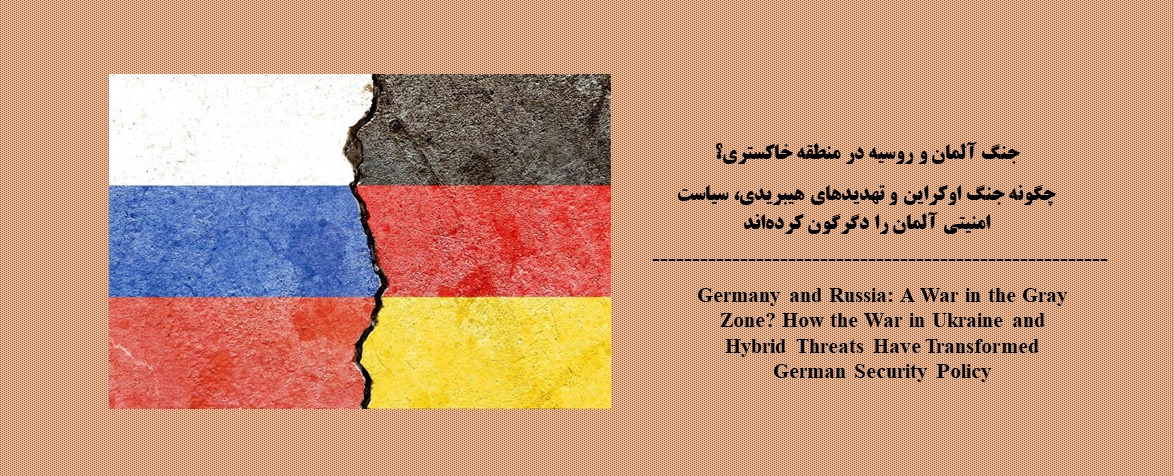
On October 1, in the city of Münster, German Chancellor Friedrich Merz warned that the country must prepare for increased and even more severe hybrid attacks from Russia. In the same speech, he characterized German vacillation as a precursor to the destabilization of Europe and subsequently Ukraine, emphasizing that pressures attributed to Moscow must not lead to a reduction in Berlin’s support for Kyiv. These remarks do not so much signal the commencement of a formal war between the two nations as they describe a state of affairs in which German-Russian relations can no longer be explained through the lens of conventional peace, economic competition, or diplomatic disagreement, yet have not yet escalated to direct military confrontation. The question mark in the title reflects this very ambiguity: the primary arena of confrontation is the “gray zone” between peace and war—a space where security, intelligence, cyber, and political pressures are applied to impose costs and alter the opponent’s calculus, often without the operations being proven in a manner that would render a direct military response feasible or inevitable (Bundesregierung, 2026a; Deutschlandfunk, 2026).
The incident at Leipzig/Halle Airport in August 2026 transformed this situation from an abstract debate into a tangible reality for the German public. The discovery of an explosive-laden drone within the airport perimeter, its investigation by security agencies, and its subsequent political attribution to Russia by the German government demonstrated that Berlin no longer views hybrid threats merely as a series of scattered cyberattacks or influence operations. Instead, it perceives them as part of a strategic pressure campaign against the country’s infrastructure and political will. Although Moscow denied the allegations, the significance of the incident lay not just in the potential damage, but in the shift it triggered in the German government’s rhetoric and behavior: a move from general warnings to public attribution, enhanced protection of critical infrastructure, and an effort to establish deterrence against actions that remain below the threshold of direct warfare (Ahmadi, 2026a; Bundesregierung, 2026b).
To understand why Germany has become the focal point of this pressure, one must consider its position in Europe’s strategy toward the war in Ukraine. Germany is the European Union’s largest economy, a primary provider of financial and military aid to Ukraine, a critical hub for the transit of NATO forces and equipment, and a decisive actor in maintaining European sanctions. Simultaneously, German society lacks a consensus on increasing defense spending, arms deliveries, the economic consequences of sanctions, and the future of relations with Russia. Consequently, imposing costs on Germany can both strain the material capacity for supporting Ukraine and exacerbate existing political and social fissures. Merz’s assertion that German vacillation leads to the faltering of Europe and then Ukraine effectively encapsulates this link between Germany’s internal security, European political cohesion, and Ukraine’s resilience.
Merz’s unannounced visit to Kyiv on October 4 must also be viewed within this framework. He traveled to Ukraine as Russian attacks on Ukrainian cities and energy infrastructure intensified. By asserting that if the Russian war machine is not stopped, it will eventually target other European nations, he explicitly framed support for Ukraine as an integral part of defending German security. The presence of Economy Minister Katharina Reiche and several executives from German defense and energy companies on this trip indicated that Berlin’s policy is no longer solely based on financial aid or weapons shipments. Rather, it is increasingly focused on linking Ukraine’s energy reconstruction, industrial cooperation, and the joint production of defense and drone systems to Europe’s long-term security. The announcement of fresh military aid and resources for repairing energy infrastructure, alongside a program for developing defense industry cooperation, sent a clear message to Moscow: military and hybrid pressures will not erode Berlin’s resolve to support Kyiv; instead, they may further transform Germany into a sustained industrial and security backbone for Ukraine. Nevertheless, this choice carries domestic political costs, remaining a central point of partisan contention over Russia and Ukraine, particularly in an environment where segments of German society remain skeptical about the war’s duration and costs (Bundesregierung, 2026c; Reuters, 2026).
This formulation is also part of a larger narrative struggle. The German government presents its support for Ukraine, the strengthening of NATO’s eastern flank, and the protection of domestic infrastructure as a defensive reaction to Russian policy. Conversely, Moscow views NATO expansion, the delivery of long-range weapons, and Germany’s increased military presence in Eastern Europe as signs of an escalating containment policy. Consequently, actions deemed essential by one side to enhance deterrence are viewed by the other as increasing the scope of the threat. This is the “security dilemma” now being reproduced not only in troop and weapon deployments but also in domains such as cybersecurity, infrastructure protection, investment controls, travel restrictions, and the war of narratives. From this perspective, the gray zone is not a peripheral aspect of the Ukraine war, but one of the primary conduits through which it spills over into Europe.
The roots of this situation lie in the gradual collapse of the post-Cold War European security order. For nearly three decades, a significant portion of German policy was based on the assumption that trade, energy interdependence, political dialogue, and multilateral institutions could keep Russia within the European order and increase the cost of confrontation for all parties. The 2014 annexation of Crimea severely weakened this premise, and Russia’s invasion of Ukraine in February 2022 shattered its political foundations. Since then, the policy of “Wandel durch Handel” (Change through Trade) has been replaced by sanctions, reduced energy dependence, increased defense spending, and the reinforcement of NATO’s eastern flank. This shift has not only transformed relations between Berlin and Moscow but has also pivoted the logic of European security architecture from cooperation and conflict management toward containment and deterrence (Ahmadi, 2026b).
The diminishing role of arms control mechanisms and the inability of institutions like the OSCE to prevent war or rebuild trust have intensified this pivot. In response, NATO has once again become the central institution of European security, and the EU has transcended its primarily economic and regulatory role to become more active in sanctions, defense industries, energy security, and the financing of Ukraine. For Germany, this evolution represents a difficult departure from an identity that defined its power largely in economic, institutional, and civilian terms. Berlin is now compelled to strike a new balance between its historical and social constraints and the expectations of its European partners to shoulder a greater share of the defense burden and responsibility. Thus, the conflict with Russia has also become a litmus test for Germany’s future standing in the European security order.
Berlin’s practical response can be seen in the integration of its foreign and domestic levels. Externally, the permanent deployment of a German brigade to Lithuania, increased defense budgets, the development of the arms industry, and continued support for Ukraine signal the return of “hard power” to the country’s security policy. Internally, the implementation of the Critical Infrastructure Protection Act, the setting of common standards for sectors such as energy, transport, water, communications, and health, the creation of coordination mechanisms between the police, military, and intelligence agencies, and the development of drone detection and neutralization capabilities have expanded the concept of defense from border protection to the safeguarding of the vital functions of the state and society (Bundesregierung, 2026b). The goal of these measures is not to choose a direct military response, but to make sub-threshold operations more difficult, costly, and ineffective, while preserving Germany’s capacity to sustain its policy toward Ukraine.
However, the gap between policy pronouncements and the creation of actual capabilities remains significant. This difficulty is most evident in Germany’s fragmented political landscape. While the coalition government, the CDU/CSU union, the Greens, and a significant portion of the SPD agree on the long-term threat posed by Russia and the necessity of supporting Ukraine, they diverge on the scope of military aid, the methods of financing defense costs, the role of diplomacy, and the limits of security agencies’ powers. Conservatives generally emphasize deterrence and military readiness; Social Democrats couple support for Ukraine with the necessity of maintaining diplomatic channels and arms control; and the Greens typically advocate for broader and faster support for Kyiv (CDU, 2025; SPD-Bundestagsfraktion, 2026; Deutscher Bundestag, 2026c). These differences still fall within the general framework of containment but impact the speed and form of its implementation.
On the other side, the Alternative for Germany (AfD) remains the most prominent opponent of current policy, seeking a reduction in financial and military aid to Ukraine, opposing its EU membership and military guarantees, and viewing the phased lifting of sanctions on Russia as an incentive for negotiation. Portions of the Left Party and the Wagenknecht movement also emphasize social costs, the risk of war expansion, and the necessity of negotiations, albeit from different ideological foundations. The overlap of these forces in opposing weapon deliveries or sanctions does not imply they are identical or prove an organizational link to Russia. Nevertheless, the existence of such a divide indicates that policy toward Russia and Ukraine has become a primary fault line in German partisan and electoral competition.
In conclusion, the German-Russian confrontation in the gray zone is a symptom of Europe entering an order where peace and war are no longer two entirely distinct states. Germany does not face a simple choice between dialogue and deterrence. The core challenge is how to increase the cost of sub-threshold operations without falling into a cycle of uncontrollable escalation, while sustaining support for Ukraine and the security of eastern allies, and maintaining the democratic legitimacy of its policy at home. This issue takes on broader dimensions when considering Sergey Lavrov’s recent remarks at the UN General Assembly regarding the “remilitarization” of Germany and Japan. Moscow seeks to frame current developments not merely as a reaction to the Ukraine war, but as a sign of the return of power politics and a revision of the post-WWII settlement—a subject whose relationship to the evolving international and European security orders warrants a separate analysis.
References:
احمدی، ب. (۱۴۰۵الف، ۱۱ شهریور). از یک حادثه امنیتی تا مرز تازه تقابل با روسیه [یادداشت تحلیلی].
احمدی، ب. (۱۴۰۵ب). سیاست خارجی آلمان در پرتو تحولات بینالمللی (۲۰۱۴–۲۰۲۵) از منظر واقعگرایی نوکلاسیک. رهیافتهای سیاسی و بینالمللی، ۱۸(۲)، ۸۷–۱۱۲.
https://piaj.sbu.ac.ir/article_106902_2f83404c6d4d41d7372abeb24310fa83.pdf
AfD-Fraktion im Deutschen Bundestag. (n.d.). Positionspapier zum Russland-Ukraine-Krieg. https://afdbundestag.de/ukrainekrieg/
Bundesregierung. (2026a, October 1). Kanzler Merz beim Deutsch-Niederländischen Korps in Münster. https://www.bundesregierung.de/breg-de/suche/kanzler-beim-korps-in-muenster-2455246
Bundesregierung. (2026b, September). Was tut die Bundesregierung gegen hybride Angriffe und Drohnenvorfälle? https://www.bundesregierung.de/breg-de/aktuelles/hybride-bedrohung-fragen-antworten-faq-2449150
CDU. (2025, October). Hybride Bedrohungen wirksam abwehren. https://www.cdu.de/aktuelles/aussen-und-sicherheitspolitik/hybride-bedrohungen-wirksam-abwehren/
Deutschlandfunk. (2026, October 1). Merz warnt vor wachsender Gefahr durch Russland für Deutschland und Europa. https://www.deutschlandfunk.de/merz-warnt-vor-wachsender-gefahr-durch-russland-fuer-deutschland-und-europa-102.html
Deutscher Bundestag. (2026a, June 25). Haltung der AfD zum Ukraine-Krieg stößt auf breiten Widerspruch. https://www.bundestag.de/dokumente/textarchiv/2026/kw26-de-aktuelle-stunde-ukraine-1191868
Deutscher Bundestag. (2026b, September 24). Antrag gegen EU-Mitgliedschaft und Beistandsgarantien für die Ukraine. https://www.bundestag.de/dokumente/textarchiv/2026/kw39-de-ukraine-1216892
Deutscher Bundestag. (2026c, July 8). Antrag zur militärischen Unterstützung der Ukraine abgelehnt. https://www.bundestag.de/dokumente/textarchiv/2026/kw28-de-ukraine-1192530
SPD-Bundestagsfraktion. (2026, September 1). Russische hybride Angriffe: Bundesregierung muss entschlossen handeln. https://www.spdfraktion.de/presse/statements/russische-hybride-angriffe-bundesregierung-muss-entschlossen-handeln
Bundesregierung. (2026c, October 4). Federal Chancellor Merz in Kyiv: “You can continue to count on our support.” https://www.bundesregierung.de/breg-en/news/federal-chancellor-merz-kyiv-2455678
Reuters. (2026, October 4). Merz unveils fresh military aid in Kyiv, says Germany won’t be intimidated.
https://inaes.ut.ac.ir/en/article/278028782