
Print


31 07 2026 00:54
News Code : 251599419
View Count : 947
Emerging technologies have never been so consequential in shaping the trajectory of economic, security, social, scientific, and governance developments; yet they have also never been so difficult to understand, assess, and incorporate into decision-making.
Emerging technologies have never been so consequential in shaping the trajectory of economic, security, social, scientific, and governance developments; yet they have also never been so difficult to understand, assess, and incorporate into decision-making. Breakthrough advances in areas such as ChatGPT, COVID-19 mRNA vaccines, small commercial satellites, intelligent systems, novel biotechnologies, and quantum computing indicate that the world has reached a decisive juncture in technological transformation. This moment creates immense potential for growth, prosperity, health, productivity, and national capability, while simultaneously generating unprecedented challenges relating to regulation, security, ethics, supply chains, strategic competition, and the legitimacy of public decision-making. Under such circumstances, policymakers and public-sector managers need accurate, accessible, continuous, and comprehensible analytical resources more than ever, so that they can distinguish genuinely consequential trends, institutional implications, and policy options from the vast volume of specialized developments.
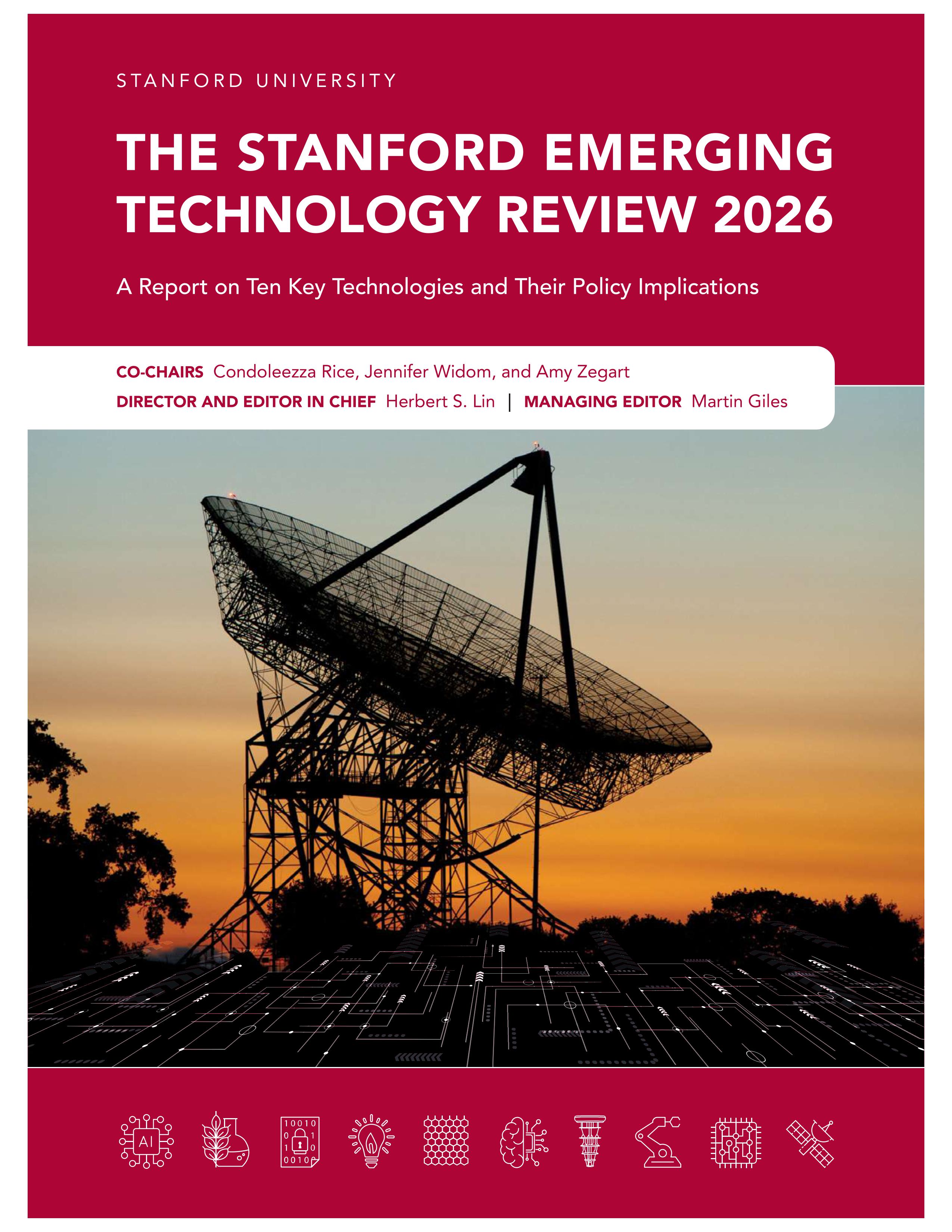
The Stanford Emerging Technology Review 2026 (SETR 2026) has been designed to address precisely this need. Drawing on the expertise of distinguished Stanford University faculty members across a range of scientific and engineering fields, the report examines ten key technological domains and seeks to bridge technical knowledge, strategic understanding, and policy considerations. The report’s significance lies not merely in its introduction of a set of new technologies, but in its elevation of technology beyond a purely technical subject, reframing it as an issue intrinsically connected to national power, geopolitical competition, economic growth, public health, environmental sustainability, civil society, and governance capacity. For public institutions and decision-makers, therefore, this framework is not simply a technology report; rather, it constitutes a tool for translating scientific developments into the language of decision-making and institutional action.
[1] The Stanford Emerging Technology Review (SETR) 2026
https://inaes.ut.ac.ir/en/article/251599419