
Print


06 09 2026 18:56
News Code : 267955927
View Count : 867
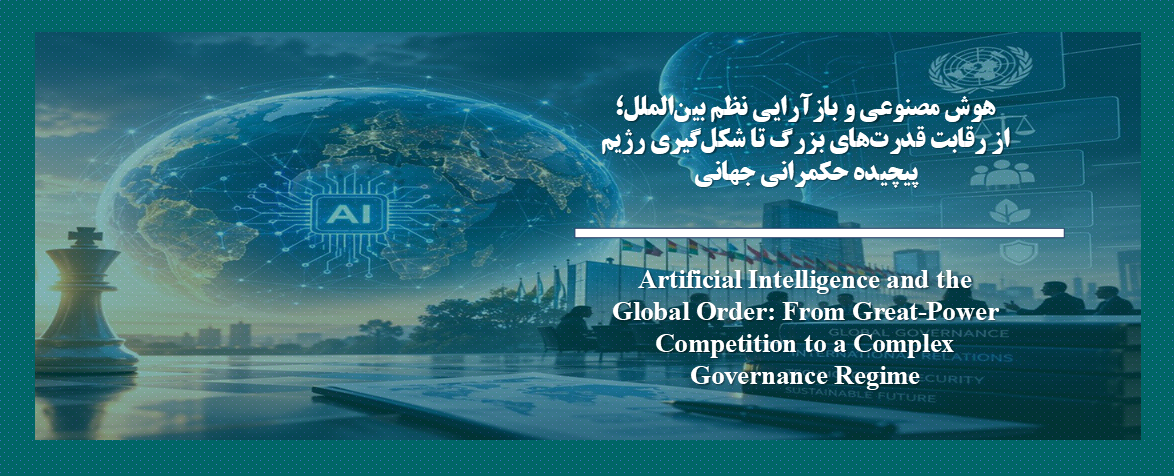
The international system is passing through one of its most significant periods of transition. Shifts in the distribution of power, the intensification of great-power competition, the emergence of strategic technologies, and changes in patterns of international cooperation have all put many of the assumptions of the existing order under strain. Amid these developments, artificial intelligence is no longer merely an emerging technology or a subject belonging to the domains of science and the economy; it has become one of the new components of power, security, and geopolitical competition.
By: Seyyed Amir Arash Eshaghi
MA in European Studies; Member of the Global Issues Studies Group
The international system is passing through one of its most significant periods of transition. Shifts in the distribution of power, the intensification of great-power competition, the emergence of strategic technologies, and changes in patterns of international cooperation have all put many of the assumptions of the existing order under strain. Amid these developments, artificial intelligence is no longer merely an emerging technology or a subject belonging to the domains of science and the economy; it has become one of the new components of power, security, and geopolitical competition.
AI matters because, unlike many earlier technologies, it affects the economic, scientific, military, and intelligence domains simultaneously — and even the very capacity of states to exercise power. From this standpoint, the central question of the AI era is not simply how a new technology should be regulated; the more important question is who will determine the rules governing the use of this technology, and how those rules will shape the future international order.
From Technology to a Component of Power
Understanding AI’s place in global politics requires moving beyond a purely technological perspective. Advanced AI capabilities are gradually becoming part of the infrastructure of national power. Access to data, computational capacity, advanced chips, capital, specialized human capital, and the ability to develop foundation models can all generate new strategic advantages.
This transformation can be observed at four levels. At the economic level, AI can reshape the productivity dominant position in the chip supply chain, computing infrastructure, and logical level, countries that achieve a dominant position in the chip supply chain, computing infrastructure, and advanced models will enjoy a structural advantage. At the military level, AI transforms the capacity for intelligence analysis, decision support, operational management, and the development of autonomous systems. Finally, at the institutional and geopolitical level, the ability to set the standards and rules for the use of this technology can itself become a source of power.
The competition of the future, therefore, will be over not only “which country has more powerful AI,” but also which country can shape the rules, standards, and norms governing its use.
The United States and China: Competition over Technology and Rules
In this context, the competition between the United States and China is of particular importance. AI is becoming one of the principal arenas of strategic rivalry between the two great powers — a rivalry that is by no means confined to the development of AI models and extends to areas such as advanced chips, computing infrastructure, investment, technology supply chains, military applications, and standard-setting.
From this perspective, AI is part of the broader contest to determine the shape of the future international order. Each of the great powers will seek to expand its technological capabilities while reducing its strategic dependencies and securing a greater role in shaping international rules.
This situation has an important consequence: global AI governance cannot be separated from the geopolitics of power. Even if all states agree on the necessity of “responsible” or “safe” AI, the definitions of responsibility, safety, equitable access, and even the boundary between legitimate and illegitimate uses of this technology can be influenced by the divergent interests and perceptions of the great powers.
Why a World Government for AI Will Not Emerge
Given the complexity of the technology and the multiplicity of actors, the emergence of a fully centralized and integrated global system for AI governance seems unlikely. States are not prepared to surrender their full capacities in matters of national sovereignty and strategic security to a single central global body. Moreover, the pace of technological change is such that traditional international institutions can barely keep up with it.
AI is also not a single issue. Scientific development, the digital economy, human rights, access to technology, cybersecurity, military applications, the labor market, and sustainable development each require a distinct set of rules and actors.
For this reason, the future of AI governance will probably take shape not as a “world government for AI,” but as a constellation of institutions, agreements, standards, and multilateral arrangements.
The Emergence of a “Regime Complex” for AI Governance
One concept well suited to explaining this situation is that of a governance regime complex: a set of institutional and multilateral arrangements that — in the absence of a single center — manage a the absence of a single center — manage a complex global domain through a division of labor and, the United Nations, states, scientific institutions, technology companies, specialized organizations, civil society, and even regional arrangements can all play a simultaneous role in shaping AI governance.
The report of the UN High-Level Advisory Body on AI likewise emphasizes the existence of a kind of “gap in the global governance” of this technology and stresses the need for an inclusive, networked, and flexible approach. The report also underlines the importance of building a shared global understanding of AI’s capabilities, opportunities, risks, and uncertainties.
This approach shows that the central task is not necessarily to create a single organization; it is to build coordination among a set of existing and emerging institutions.
Within such an architecture, at least four essential functions can be envisaged for global AI governance: building a shared scientific understanding, developing standards, distributing the benefits of the technology more equitably, and strengthening collective security.
Science as Governance Infrastructure
One of the key points in this architecture is the role of independent scientific knowledge. The pace of AI development means that policymakers frequently make decisions in conditions where no complete understanding of the technology’s capabilities, risks, and consequences yet exists.
In such circumstances, establishing an independent scientific mechanism at the global level could narrow the gap between expert knowledge and policymaking. Such a mechanism could provide governments with scientific assessments and, to some extent, reduce the information asymmetries among countries.
In fact, the future of AI governance depends not only on “rules”; it also depends on the existence of a shared scientific basis for decision-making. Without such a basis, even international agreements may fall prey to divergent perceptions and political rivalries.
Military Security: The Hardest Test for AI Governance
The most complex part of AI governance is likely to be the military and security domain. In the past, discussion of AI’s military applications focused mainly on lethal autonomous weapon systems, but the scope of this technology now extends far beyond that. Intelligence analysis, target identification, decision support, operational management, and autonomous systems can all transform the structure of military decision-making.
The fundamental problem is that the increased speed and capacity of decision-making may go hand in hand with a reduction in the time available to humans for crisis assessment. In conditions of great-power competition, such a situation can affect deterrence, strategic stability, and crisis management.
AI governance in the military domain, therefore, cannot be confined to drafting technical standards. Security dialogue, confidence-building, transparency, accountability, and the creation of communication mechanisms among the great powers will also be essential.
From this perspective, the future of military AI will be part of the future of the international peace and security architecture.
The Less-Visible Issue: The Global AI Divide
Another dimension of AI governance is the unequal distribution of this technology’s capabilities. If access to advanced chips, computing infrastructure, data, capital, and specialized human capital becomes concentrated in a limited number of countries and companies, AI could widen the gap between technology-rich and technology-poor countries.
From this standpoint, the “equitable distribution of the benefits of technology” should not be treated merely as an ethical slogan; it is part of the very question of the stability of the international order. A widening technological gap can create new economic and political dependencies, leaving countries without infrastructure in a position where they are largely consumers of rules and technologies produced elsewhere in the world.
Global AI governance must therefore attend, beyond the management of risks, to the issues of access, capacity-building, and the participation of developing countries.
Iran in the Emerging Architecture
For Iran, developments in global AI governance cannot be understood as a purely technological matter. These developments are intertwined with issues of economic development, national security, sanctions, access to technology, foreign relations, and Iran’s place in the global economy.
Restricted access to advanced technologies and computing infrastructure could be one of the major obstacles to developing Iran’s AI capacities. At the same time, Iran’s presence in international debates on the rules and standards of artificial intelligence will grow in importance.
If Iran merely waits for global rules to take shape, it will likely end up in the position of a “rule-taker.” Active participation in scientific, regional, and international forums, by contrast, can increase the prospects of influencing the formation of future norms and standards.
In this regard, Iran’s policy can be organized around three axes: strengthening scientific and human capacity, developing regional and international cooperation, and taking an active part in dialogues on global AI governance.
Conclusion: The Contest over the Future of the World Order
AI is becoming one of the important components of power in the international system; but its significance is not exhausted by its technological capabilities. AI can affect the distribution of economic and military power, great-power competition, international security, and even the ability of states to set rules.
In such conditions, the likelihood of a centralized global system for AI governance is limited. What appears more likely is the emergence of a complex, multilayered governance regime in which states, international organizations, scientific institutions, technology companies, and other actors will be compelled to cooperate — even alongside their competition.
The success of this architecture, however, depends on a fundamental question: Can the international community strike a balance between great-power competition and the imperative of global cooperation? From this standpoint, the defining question of the future is no longer simply “Who will have more powerful AI?”
The more decisive question is this:
Who will determine the rules governing the use of AI, which countries will play a part in drafting these rules, and what kind of international order will these rules bring into being?
The answer to this question may well determine whether AI ultimately becomes a factor that deepens geopolitical divides and rivalries, or a platform for a new form of cooperation and global governance.
References
CSIS, Center for Strategic and International Studies, (2025). Four scenarios for the geopolitical order, 2025–2030: What will great-power competition look like.CFR, Council on Foreign Relations, (2025). How experts think AI will change the global balance of power by 2035. Council on Foreign Relations.Klein, Emma, & Patrick, Stewart, (2024). Envisioning a Global Regime Complex to Govern Artificial Intelligence. Carnegie Endowment for International Peace.United Nations, (2024). Governing AI for humanity: Final report of the UN Secretary-General’s High-Level Advisory Body on Artificial Intelligence.United Nations Independent International Scientific Panel on Artificial Intelligence, (2026). Preliminary report. United Nations.United Nations, (2025). Institute for Disarmament Research, Artificial intelligence in the military domain: Implications for international peace and security. UNIDIR.
https://inaes.ut.ac.ir/en/article/267955927